
OpenAI has announced its latest reasoning models, dubbed ‘o3,’ as successors to the o1 series.
Skipping the name o2 due to trademark complications, the o3 models are being hailed as a significant step toward Artificial General Intelligence (AGI).
While OpenAI remains cautious in labeling o3 as AGI-ready, the models demonstrate capabilities that approach AGI in specific contexts, marking a remarkable milestone in AI development.
Breakthrough in Reasoning Capabilities
The o3 series includes the main o3 model and the o3-mini, a smaller version optimized for specialized tasks.
François Chollet, the creator of Keras and founder of the ARC Prize, collaborated with OpenAI to evaluate o3’s performance using the ARC-AGI benchmark.
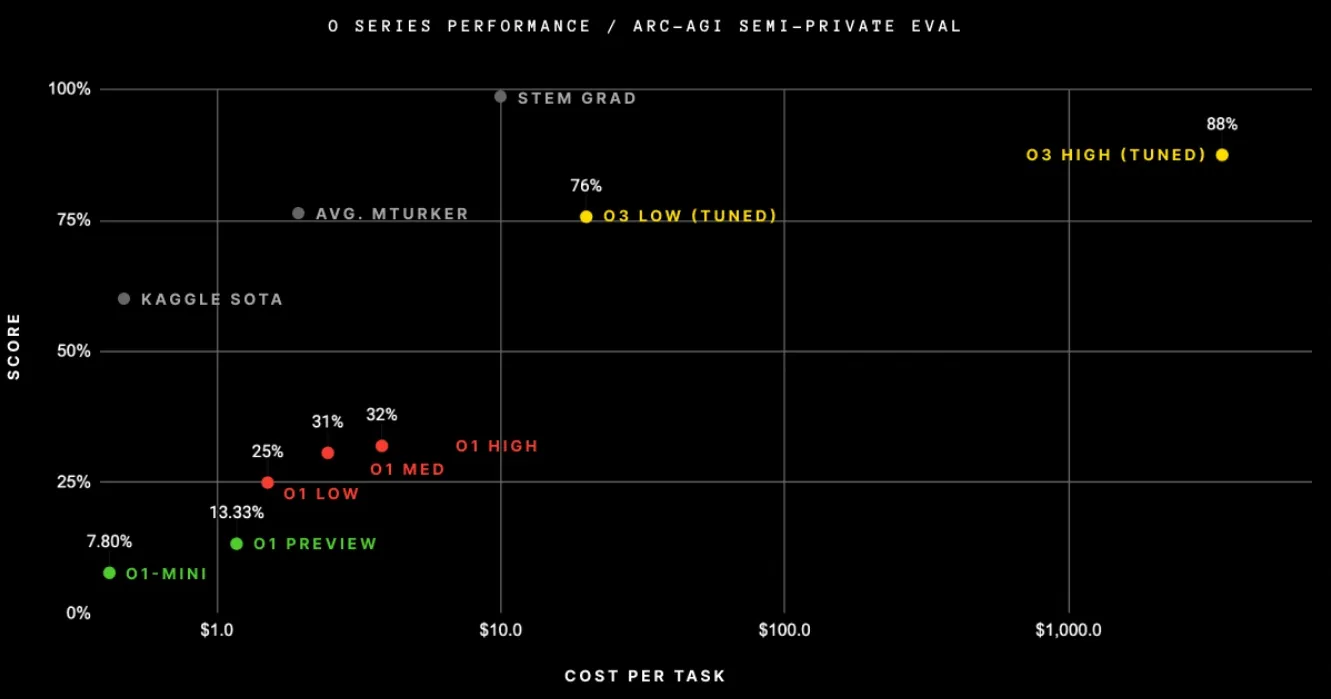
Chollet shared his assessment on X (formerly Twitter), highlighting o3’s impressive performance, achieving a 75.7% score on the semi-private evaluation in low-compute mode.
However, Chollet emphasized that o3 has not yet achieved full AGI. He noted that the model struggles with some straightforward ARC-AGI-1 tasks and is expected to face significant challenges with ARC-AGI-2.
This highlights the ongoing potential to create benchmarks that are simple for humans but remain out of reach for AI.
Release Plans and Availability
Currently, neither o3 nor o3-mini is publicly available.
Safety researchers can sign up for a preview of o3-mini starting today, with a broader release planned for late January.
The main o3 model is expected to follow shortly after.
OpenAI has not provided a specific timeline for its release, but the rapid development cycle suggests an accelerated pace.
Competition in AI Reasoning Models
The announcement of o3 comes just three months after OpenAI launched its o1 reasoning model.
This rapid progression underscores OpenAI’s commitment to advancing reasoning AI capabilities.
According to Noam Brown, OpenAI anticipates this release cycle will only accelerate further.
OpenAI’s advancements have spurred competition in the field. Google recently announced its Gemini 2.0 Flash Thinking Experimental model, part of its AI Studio platform.
However, early tests indicate that Gemini 2.0 still lags behind OpenAI’s o3 in terms of performance and reasoning capabilities.
The Road Ahead
The unveiling of o3 represents a major leap forward in AI reasoning. Although AGI remains a distant goal, o3 showcases significant progress in adapting to novel tasks and solving complex problems.
With further developments and iterations, OpenAI’s o3 series could redefine the landscape of AI reasoning.